
How Much Does Shop Front Window Cleaning Cost in Edinburgh?
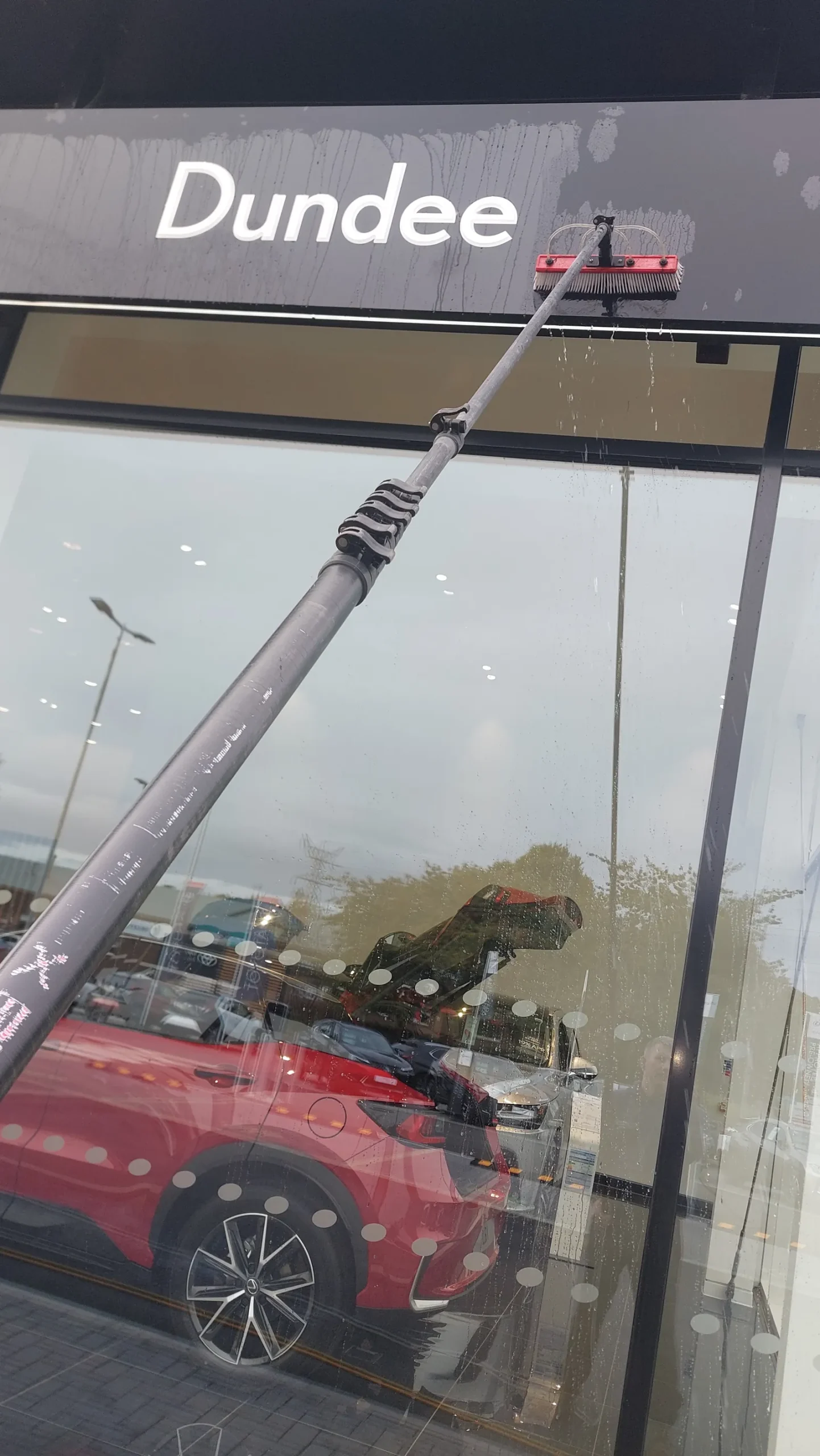
Shop front window cleaning in Edinburgh is usually priced on a schedule rather than a one-off job, and the figure you get depends on frontage size, how many floors of glass are involved, how the windows are accessed and how often you want a visit. There’s no single flat rate because a small Stockbridge boutique and a three-storey George Street office with ground-floor retail are entirely different jobs. We cover this in more detail on our window cleaning in Edinburgh page, but this post sets out exactly what shapes the price so you know what you’re asking for before you get a quote.
How much does window cleaning cost in Edinburgh?
There’s no single published rate for shop front window cleaning in Edinburgh because cost depends on frontage width, number of panes, floor count, access method and how often you book, rather than one flat figure. A ground-floor single unit costs far less to maintain than a multi-storey glass frontage needing poles or rope access.
The honest answer is that anyone quoting a fixed city-wide number without seeing your premises is guessing. What we can tell you is what actually moves the price: the size and height of the glass, whether it’s reachable from the pavement or needs a water-fed pole or rope access, how dirty it gets between visits (city centre traffic grime builds faster than a quiet suburban unit), and whether you want a contract or a single clean. We quote after a quick look at the premises, which is the only way to give you a figure that holds up.
What does shop front window cleaning actually include?
Shop front window cleaning covers the ground and first-floor glass customers see from the pavement, including the main display windows, door glass, fascia glazing and often the frame and sill. A proper job also wipes down sills and ledges, which collect grit and pigeon mess faster than any other part of the frontage.
For a retail unit this is usually the single most visible cleaning job you pay for, because it’s the first thing a customer sees before they even walk in. We treat it as a standalone service on our shopfront cleaning page, separate from general office window cleaning, because the standard expected is higher and the visit is usually more frequent. Streaks, smears or a dirty strip along the bottom edge all stand out on a shop front in a way they never would on an upstairs office window.
How is shop front window cleaning priced differently from office window cleaning?
Shop front pricing tends to be driven by frequency and finish, whereas office block pricing is driven more by floor count and access method. A busy retail frontage usually needs weekly or fortnightly visits to stay presentable, while an office tower might only need monthly or quarterly cleans but requires far more complex access equipment.
A single-storey shop on Morningside Road with a wide display window is a quick, repeatable job. A five-storey office on Lothian Road with mixed glazing heights might need a water-fed pole for the lower floors and rope access or a cherry picker for the top ones, which changes the cost structure completely. If you’re comparing quotes for an office building specifically, our post on who offers office window cleaning in Edinburgh goes into that side of things.
How often should a shop front be cleaned in Edinburgh city centre?
Most Edinburgh city centre shop fronts are cleaned weekly or fortnightly because traffic pollution, pavement grit and weather splashback build up quickly on ground-floor glass. Quieter suburban units or industrial units can often go monthly without looking neglected.
Royal Mile, Princes Street and George Street frontages take a battering from footfall, bus exhaust and seasonal grit spreading during winter, so a monthly clean there will look tired well before the next visit. A quieter unit in Corstorphine or Leith Walk with less passing traffic can stretch further between cleans. We set the schedule around what the premises actually needs rather than a fixed rule, and we’ll tell you honestly if weekly is overkill for your location.
What cleaning method is used for ground and first floor shopfronts?
Ground and first-floor shop windows are usually cleaned with a traditional squeegee and cleaning solution, or with a water-fed pole system using purified water for a streak-free, spot-free finish. Both methods are safe for most glass types, and the choice usually comes down to reach, frontage shape and finish preference.
Traditional squeegee work is still the fastest and most controllable method for straightforward ground-floor glass, especially where there’s fine detail around a shop sign or leaded panels. Water-fed pole systems come into their own on first-floor glass that can be reached from the pavement without ladders, using filtered water that dries without the mineral spots hard Edinburgh tap water can leave behind. We choose the method that suits the glass, not the other way round.
How do you clean upper floor shop windows without ladders?
Upper floor shop windows above the first storey are usually cleaned using telescopic water-fed poles from ground level, which can reach several storeys without a ladder, or with rope access or a mobile elevating platform on taller buildings. The method depends on height, frontage layout and what’s safe for pedestrians below.
A lot of Edinburgh high street units sit beneath flats, so the shop glazing might only be ground and first floor while the building continues upward with residential windows that aren’t part of the job at all. Where a retail unit does have upper glazing, poles usually cover three or four storeys comfortably. Beyond that, or where access is restricted, rope access becomes the safer and more practical choice, which we cover in detail on our rope access page.
Is rope access needed for shop front or high street buildings?
Rope access is occasionally needed for shop fronts attached to taller buildings where upper glazing, signage or cladding sits beyond safe pole reach and a cherry picker can’t get close enough on a busy pavement. For most single or two-storey retail units, it isn’t required at all.
Where it does come in useful is on tenement blocks with ground-floor retail, where the shop glass is straightforward but the building above needs IPAF-trained operators or rope access technicians for upper windows, signage or stonework. Our technicians hold IPAF qualifications and we work under Safe Contractor, Constructionline and CHAS accreditation, which matters on sites with restricted access or where a managing agent needs proof of competence before letting anyone work at height. You can read more about when this applies in our post on rope access in Edinburgh: when do you need it and how does it work.
Does gutter cleaning cost extra alongside window cleaning?
Yes, gutter cleaning is priced separately from window cleaning because it involves different access, equipment and time, though many Edinburgh businesses book both together to cut down on separate call-outs. Combining visits is often more cost-effective than booking two different contractors on two different days.
Gutters above a shop front or commercial unit fill with moss, leaf debris and grit faster than most owners expect, and a blocked gutter over a shop entrance can cause an overflow that stains the very glass you’ve just had cleaned. If you’re already paying for window access equipment to be on site, it usually makes sense to have gutters checked and cleared at the same time rather than arranging it as an afterthought.
Can gutter cleaning be done at the same visit as window cleaning?
Gutter cleaning can usually be carried out during the same visit as window cleaning where the same access method, such as a water-fed pole or rope access, reaches both. This saves on repeat site visits and is a sensible way to maintain the whole frontage in one go.
It’s worth flagging gutter condition when you book your window clean rather than waiting until there’s a visible leak or staining down the frontage. On tenement and older commercial buildings in particular, cast iron guttering needs more frequent checking than modern uPVC, and debris sitting unseen above a shop can cause damp patches that are expensive to put right later. Booking both together is one of the simplest ways to avoid that.
What’s the difference between commercial window cleaning and standard window cleaning?
Commercial window cleaning covers business premises such as shops, offices and retail units, usually on a scheduled contract, with risk assessments, method statements and accredited operators where height or public access is involved. It’s built around reliability and compliance rather than a one-off visit.
A business can’t afford a cleaner who turns up when it suits them, because a grubby shop front costs trade and a missed office clean looks unprofessional to visiting clients. Commercial contracts are set up with a fixed schedule, a named point of contact and proper insurance and accreditation behind the work, which is exactly how we operate under Safe Contractor approval, Constructionline membership and CHAS accreditation. You can see the full scope of what that involves on our commercial cleaning contractor page, and in our related post on what a commercial cleaning contractor in Edinburgh actually does.
Do you clean inside and outside glass for shop fronts?
Both inside and outside glass can be cleaned for shop fronts, though most regular contracts focus on the exterior since that’s what passing trade sees, with internal glass added on request or at a reduced frequency. Interior cleaning usually needs access during opening hours or an agreed out-of-hours slot.
Outside glass takes the brunt of weather, traffic and pavement spray so it needs attention more often. Inside glass stays cleaner for longer unless there’s a lot of handling around a door or till area. Many shops have exterior cleaning weekly or fortnightly and interior glass done monthly or as part of a wider internal commercial clean, which our cleaning services cover alongside window work.
How does Edinburgh’s weather affect window cleaning frequency?
Edinburgh’s weather, particularly coastal wind off the Forth, driving rain and winter grit spreading, speeds up how quickly shop glass gets dirty compared with calmer, drier parts of the country. Frontages exposed to wind-blown rain or busy roads need more frequent attention to stay presentable.
A shop front on a windy stretch near Leith or Portobello picks up salt spray that leaves a dull film on glass if it isn’t cleaned regularly. Grit spread on pavements and roads during winter gets kicked up onto lower glass and sills, which is one reason ground-floor shop windows often need a tighter schedule than upper-floor office glazing that’s sheltered from splashback. We factor local exposure into the schedule we recommend rather than applying a blanket frequency across every site.
Does the type of building affect the cost?
Yes, building type affects cost because older sandstone tenements, listed buildings and conservation area properties often come with access restrictions, delicate stonework nearby and sometimes traditional sash and case glazing, all of which can change the method and time needed compared with a modern retail unit.
A lot of Edinburgh’s shop fronts sit at ground level beneath Georgian or Victorian tenements, which means any work at height on the building above has to consider soft, porous sandstone, close proximity to neighbouring flats, and sometimes conservation area conditions on what equipment can be used. The shop glazing itself is rarely the complication; it’s what sits above and around it that can add time and care to a job.
What happens with shop front windows in conservation areas or listed buildings?
Shop fronts in Edinburgh’s conservation areas or on listed buildings can still be cleaned as normal in most cases, since routine window cleaning doesn’t alter the fabric of the building, but any access equipment used nearby, such as ladders against stonework or fixings for platforms, needs more care.
Much of Edinburgh’s city centre, including the Old Town and New Town, sits within a World Heritage Site, and while that status governs alterations to buildings rather than cleaning itself, it does mean contractors need to be sensible about how they position equipment, avoid damage to sills, mouldings or ironwork, and work at a pressure and method suited to older glass and frames. We approach every older frontage the same way: carefully, and without assuming modern methods are automatically appropriate.
How quickly can graffiti be removed from a shop front window or door?
Graffiti on shop front glass or doors can usually be removed the same day or within a day or two of being reported, since speed matters both for appearance and for discouraging repeat tagging. The method depends on whether it’s on glass, paintwork, signage or stonework.
Glass is actually one of the easier surfaces to treat because it doesn’t absorb paint or marker the way stone or render does, so a careful removal usually leaves no trace. Where graffiti has spread onto adjoining stonework, cladding or a painted fascia, the approach has to change to avoid damaging the surface underneath. We’ve written more on timing and method in our post on how quickly graffiti can be removed in Edinburgh, and our dedicated graffiti removal page covers the surfaces we treat.
Can pressure washing be combined with window cleaning for a full shop front refresh?
Pressure washing can be combined with window cleaning to refresh an entire shop front in one visit, covering the glass, door, surrounding stonework, paving outside the entrance and any signage, which gives a far more complete finish than cleaning the glass alone.
A lot of shop fronts look tired not because the glass is dirty but because the stonework, render or paving around it has built up grime that makes the whole unit look neglected even with spotless windows. Combining the two services means one team, one visit and a frontage that looks properly cared for rather than partially cleaned. Our pressure washing page explains pressure levels and surfaces in more detail, and we always match pressure to the material, since sandstone and older render need a much gentler approach than modern render or paving.
What’s included in a commercial cleaning contract versus a one-off clean?
A commercial cleaning contract covers scheduled, recurring visits at an agreed frequency with a fixed point of contact, whereas a one-off clean is a single visit with no ongoing commitment. Contracts usually work out more cost-effective per visit and keep a frontage consistently presentable rather than only tidy right after a clean.
For a shop front, a one-off clean makes sense before an opening, an event or a seasonal refresh. For ongoing trade, a contract keeps standards consistent without you having to remember to book each time. Most of the businesses we work with across Edinburgh and the central belt are on a contract because it removes the admin and guarantees the schedule holds, even during busy periods like the Festival when footfall and street grime both spike.
How much notice is needed to book a first clean?
Booking notice varies depending on the time of year and how much access equipment is needed, but a straightforward ground-floor shop front clean can usually be arranged without a long wait, while rope access or specialist equipment jobs may need a little more lead time to schedule safely.
Simple squeegee or water-fed pole work on a single unit is one of the quickest jobs to fit in. Anything needing rope access, a mobile platform, or coordination with a managing agent or neighbouring businesses takes longer to arrange properly, because risk assessments and method statements need to be in place before anyone works at height. Getting in touch early, especially ahead of a seasonal rush, gives us the best chance of fitting your preferred slot.
Do multi-branch retailers get better rates for covering several premises?
Businesses with several premises across Edinburgh, Glasgow, Fife or the Lothians often benefit from a single contract covering all sites, which simplifies invoicing and scheduling even where individual site pricing still reflects each unit’s size and access needs. One point of contact for multiple locations is usually the bigger saving.
We work across Edinburgh, Glasgow, Stirling, Dundee, Aberdeen, Kirkcaldy, Dunfermline, Fife, East Lothian, Midlothian and West Lothian, which means a retailer with branches spread across the central belt can deal with one contractor instead of coordinating separate local firms at each site. That consistency also means the same standard of finish and the same accreditation paperwork applies everywhere, which matters for businesses managing compliance across multiple locations. Our post on who offers office window cleaning in Edinburgh touches on how we handle multi-site scheduling for commercial clients.
What accreditations should a commercial window cleaning contractor hold?
A commercial window cleaning contractor working on business premises should ideally hold recognised health and safety accreditations such as Safe Contractor approval, Constructionline membership and CHAS accreditation, plus IPAF certification where any work at height is involved. These confirm the contractor has been independently assessed on safety practice and insurance.
For a shop front this matters most where a managing agent, landlord’s factor or head office requires proof of competence before any contractor is allowed on site, particularly in shared tenement buildings or managed retail parks. We hold Safe Contractor approval, are Constructionline members, are CHAS accredited and our operators are IPAF certified, which covers the paperwork most procurement teams and building managers ask for before work begins.
Is water-fed pole cleaning safe for busy pavements and shop entrances?
Water-fed pole cleaning is generally safe for busy pavements because it’s operated from ground level without ladders, ropes or overhead equipment, reducing the risk to passing pedestrians and customers entering the shop. It also avoids leaning equipment against glass or stonework.
The main consideration on a busy Edinburgh street isn’t the equipment itself but managing where the operator stands and the hose runs, so customers can still get in and out comfortably. We’re used to working around opening hours and footfall on live retail streets, timing the job so it causes as little disruption to trade as possible, often early morning before a shop opens or during a quieter midweek slot.
What’s the right way to keep a shop front looking clean between visits?
Between professional visits, the simplest way to keep a shop front looking presentable is a quick wipe of the door glass and handle area, which gets the most hand contact, and keeping the immediate pavement area free of debris that gets kicked up onto lower glass. This won’t replace a proper clean but slows how quickly grime builds.
Avoid using strong household sprays directly on signage vinyl or printed glass, since some solvents can dull or lift vinyl graphics over time. A damp microfibre cloth on the door glass is usually enough to keep fingerprints and smudges at bay between scheduled cleans, without risking damage to any branding on the glass.
Do you need to close the shop while windows are cleaned?
Most shop front window cleaning doesn’t require a business to close, since exterior cleaning is carried out from the pavement side without needing access inside, and visits can often be timed before opening or during quieter periods to avoid disrupting customers. Interior glass cleaning may need a brief window of access.
We’re happy to work around trading hours, and for busy retail units we’ll often schedule exterior cleans for early morning to have the frontage spotless before the first customers arrive. Where internal glass is part of the job, we agree a time that suits the business, whether that’s before opening, during a lull, or after close.

What areas of Scotland do you cover for shop front window cleaning?
Shop front window cleaning is carried out across Edinburgh and the wider central belt, including Glasgow, Stirling, Dundee, Aberdeen, Kirkcaldy, Dunfermline, Fife, East Lothian, Midlothian and West Lothian. For rope access and high-level work specifically, coverage also extends into Newcastle, Leeds and York.
Whether you’re running a single shop on a high street in Dunfermline or a chain of units spread between Edinburgh and Aberdeen, the same scheduling, accreditation and finish applies wherever the work is carried out. We don’t treat outlying towns as an afterthought; the same standards and the same point of contact apply across every site.
How do cladding and signage get cleaned alongside shop windows?
Cladding, fascia panels and illuminated signage can be cleaned at the same time as shop front glass, since the same access equipment, whether a pole system or rope access, usually reaches all three. This gives a consistent, fully refreshed frontage rather than clean glass surrounded by grimy signage.
Illuminated signage in particular collects grime that dulls the lit effect at night, which matters for a shop relying on visibility after dark. Cladding panels on modern retail units can also discolour unevenly if only partially cleaned. Our sign, cladding and fascia cleaning service is usually booked alongside window cleaning for exactly this reason, and our surface cleaning page covers wider stonework and render treatment where a frontage needs more than glass attention.
What happens during a first shop front window cleaning visit?
A first visit usually starts with a quick on-site assessment of frontage size, glass condition and access, followed by the clean itself using the most suitable method, whether squeegee, water-fed pole or rope access, and finishes with a check of sills, frames and door glass before the schedule for future visits is agreed.
First visits sometimes take a little longer than later ones, especially if the glass has years of ingrained grime, hard water marks or sign residue that needs extra attention. After that initial deep clean, maintaining the frontage on a regular schedule is much quicker, which is one reason the first visit and ongoing visits are sometimes priced slightly differently.
Why do businesses across Scotland choose D&A Lawrence for shop front cleaning?
Businesses choose us for shop front and commercial window cleaning because of consistent, accredited work carried out under Safe Contractor approval, Constructionline membership and CHAS accreditation, backed by IPAF-certified operators for anything at height, delivered reliably across repeat contracts rather than one-off visits.
Several of our longest-standing clients have worked with us for years across multiple locations, covering everything from window cleaning to rope access, pressure washing and facilities support, because they’d rather deal with one trusted contractor than juggle several. We take the same approach to a single shop unit as we do to a multi-storey office block: turn up when agreed, use the right method for the surface, and leave the frontage properly clean, not just rinsed.
FAQs
What is the average cost of window cleaning in the UK?
There is no one UK average that holds for business premises, because commercial window cleaning is priced on the frontage, the height of the glass, the access method and how often you book. A single ground floor shop front on a regular schedule sits at the low end, while a multi storey glass frontage needing poles or rope access costs considerably more. Frequency matters too, since a scheduled contract usually costs less per visit than a string of one off cleans. The figure worth having is a quote for your own premises, which we give after seeing the site.
How much does it cost to get all your windows cleaned?
It depends on how many floors of glass there are, how wide the frontage is and whether the upper panes can be reached by pole or need rope access. Cleaning every window on a premises, inside and out, takes longer than an exterior only visit, so it is priced as a bigger job. Booking it as a one off clean or as part of a regular schedule also changes the figure. We quote after assessing the building, so the price reflects your actual site rather than a blanket estimate.
What is the hourly rate for a window cleaner?
Commercial window cleaning is rarely charged by the hour; it is usually priced per job or per contract. That gives a business a fixed, predictable cost, rather than a bill that moves with how dirty the glass happened to be that day. The things that set the price are the frontage size, the access needed and how often the glass is cleaned. If a contractor does quote by the hour, ask how many hours they expect the job to take before you agree.
How many times a year should windows be cleaned?
For a shop front, far more often than most homes: many retail units have the outside glass cleaned weekly or fortnightly, with the inside glass done monthly. Busy high street frontages pick up traffic film, pavement spray and fingerprints quickly, which is why exterior glass needs the most attention. Upper floor windows and offices away from the street can usually go longer between cleans. Edinburgh’s wet, windy weather adds to the build up, so a regular schedule tends to work better than waiting until the glass looks dirty.
What month is best to clean windows?
There is no single best month for a shop front, because the glass faces the street all year and a regular schedule matters more than timing. A thorough clean in spring does clear the grime that builds up over an Edinburgh winter, and an autumn clean helps before the darker months. Autumn is also the time to check gutters, once the leaves have come down. For a business the better question is how often, since customers see the frontage every day of the year.
Do I need to stay home while someone’s cleaning my exterior windows?
No, exterior window cleaning does not need anyone on site, because the work is done from the outside. For a shop or office, many businesses agree a regular time slot and the visit simply happens, often early in the morning before opening. Someone only needs to be there if inside glass is part of the job, and that is agreed in advance. You do not need to close the shop either, as the work is carried out from the pavement side.
What do commercial window cleaners use to clean windows?
Most commercial window cleaners use either a cleaning solution with a squeegee or a water fed pole system that uses purified water. Purified water dries without spots or residue, which gives a streak free finish on large panes and lets upper floor glass be cleaned safely from the ground. Beyond pole reach, rope access or a mobile platform is used for high level glass. Household products such as washing up liquid tend to leave a film that attracts dust, so they are not used on commercial frontages.
Do I need to tip my window cleaner?
No, there is no expectation to tip a commercial window cleaner, because the agreed price covers the job in full. Tipping is more common on household rounds, where the same person calls every few weeks, and even there it is a personal choice. For a business, what matters far more is a reliable schedule, a consistent finish and clear communication. If you are happy with the service, a review or a recommendation to a neighbouring business is a good way to say so.
Is it worth paying for gutter cleaning?
Yes, for most commercial buildings it is, because a blocked gutter overflows and can stain walls, signage and the glass that has just been cleaned. Gutters above shop fronts fill with moss, leaves and grit faster than most owners expect. Gutter cleaning is priced separately from window cleaning, as it needs different access and time. Booking both at the same visit usually works out more efficient than two separate call outs, since the access equipment is already on site.
How to clean gutters from the ground in the UK?
Gutters can be cleaned from the ground with a gutter vacuum on lightweight extending poles, which lifts the debris out without anyone climbing a ladder. A camera on the pole lets the operator see inside the gutter and check it is clear once the job is done. It is the safest way to reach gutters on most two and three storey buildings, and nothing has to be leaned against the frontage. For higher or harder to reach gutters, rope access or a mobile platform takes over.
What is the best time of year to clean gutters?
Late autumn is the most useful time, once the leaves have come down, because that is when gutters block most quickly. A second clean in spring clears the moss and grit that build up over the winter. Buildings near trees, or with moss growing on the roof, may need more than two cleans a year. In Edinburgh’s wet weather a blocked gutter shows itself fast, usually as an overflow down the frontage.
Does gutter cleaning include downpipes?
It should, because a gutter clean is not finished until the water can run away freely. A gutter that is cleared but drains into a blocked downpipe will still overflow in the first heavy rain. Downpipes are usually checked by running water through once the gutter is clear, and any blockage is then cleared. It is worth asking for this to be included when you book, so the whole system is left working.
What is the gray black stuff on the underside of my gutters?
Those grey and black streaks are usually a mix of dirt, traffic pollution and algae, often called tiger stripes. They form where rainwater runs over the edge of the gutter and leaves a film behind as it dries. A normal wash will not shift them, so they need a cleaner made for the job that lifts them without damaging the gutter’s finish. It is a good job to do at the same visit as the gutter clean, while the access equipment is already on site.
What happens if you never clean your gutters?
The gutters fill with moss, leaves and grit until the water has nowhere to go, and it spills over the edge instead. On a commercial building that overflow can stain the walls, signage and glass below, and soak into the stonework over time. Water running down the building can lead to damp, and in cold weather it can freeze and crack the gutter itself. Cast iron gutters on tenement and older commercial buildings are especially at risk, which is why they need more frequent checking.
What’s classed as commercial cleaning?
Commercial cleaning is cleaning carried out for a business rather than a home, such as shops, offices, retail units and other business premises. For window cleaning that covers shop fronts, office glazing and high level glass, often on a regular contract with a fixed schedule. It usually takes in the rest of the frontage too, such as gutters, cladding, signage and pressure washing. The main differences from domestic cleaning are scale, access and paperwork, as many commercial sites ask for proof of health and safety accreditation first.
If you’d like a proper figure for your own shop front rather than a general estimate, get in touch through our contact page and we’ll arrange a look at the premises. You can also see the full range of what’s covered on our window cleaning in Edinburgh page, and we’re happy to talk through gutters, pressure washing, cladding or graffiti removal at the same time if your frontage needs more than glass attention.


